Deutsch
 English
CADENCE - Clausthal Approach to Digital ENgineering to boost Circular Economy
In order to support the strategic development goals at Lower Saxony's universities, the Lower Saxony Ministry of Science and Culture (Niedersächsische Ministerium für Wissenschaft und Kultur (MWK)) and the Volkswagen Foundation have launched the "Strategically Developing Potential (PSE)" funding initiative. This initiative is part of the zukunft.niedersachsen funding program, and its goals are to sharpen profiles, build on strengths, and intensify partnerships.
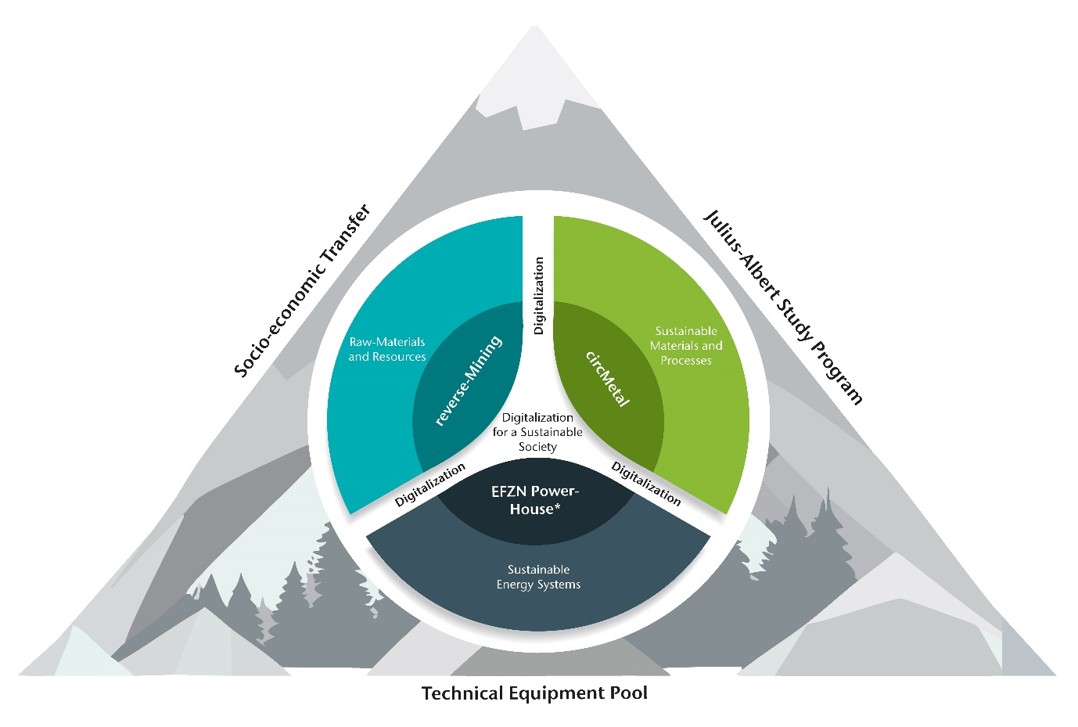
Clausthal University of Technology is receiving funding for its project “CADENCE - Clausthal Approach to Digital Engineering to boost Circular Economy” in which four interrelated measures contribute to strategically strengthening the university's potential:
The research project „Strengthening interdisciplinary research in digital engineering with a focus on blue mining and circular metals“ will consider the entire value chain, from raw materials and components to assemblies and products, as well as industrial and energy production processes. The objective is to achieve the transition to a circular economy and thus bring about a shift in thinking across society as a whole. To this end, the institution will combine interdisciplinary engineering approaches and the integration of digitalization and artificial intelligence (AI) in the following four research approaches.
- Generative AI co-pilot for circular engineering and what-if-analysis
- Data-driven secondary raw material processing for circular metal
- Modeling and prediction for blue mining
- Circular economy transformation lab
The „Julius-Albert Study Program (JAP)“ is strategically designed to enhance the onboarding, retention, and integration of students. JAP is a strategic realignment and enhancement of our academic course offerings. This initiative involves the integration of project-based teaching methodologies into various pilot engineering courses. These courses are currently being analyzed and tested to ensure their effectiveness and alignment with our educational objectives.
- Practical and relevant tasks increase students' motivation and commitment to learning.
- Neben Fachwissen werden wichtige soziale und methodische Kompetenzen wie Teamarbeit, Kommunikation, kritisches Denken und Kreativität trainiert.
- In addition to teaching specialist knowledge, important social and methodological skills such as teamwork, communication, critical thinking, and creativity are taught.
- The learning environment at TUC is becoming more attractive for students, and the length of study is developing positively.
The core facility will consolidate Clausthal University of Technology’s diverse analytical and technical research infrastructures into a unified virtual environment.
The Clausthal Geoscientific Collection is internationally renowned for its approximately 120,000 objects from the fields of mineralogy, geology, and mining. To increase visibility and transfer to society, exhibitions and performances are being developed and curated in collaboration with the Braunschweig University of Art (HBK) under the motto "Art meets Geosciences."
Project leader:
Presidential Board of TU Clausthal
Contact person:
Annika Blum, M.Sc.
Executive Assistant to the Vice-President for Research and Transfer
E-mail: annika.blum@tu-clausthal.de
Contact person for Julius Albert Study Program:
Dr. Stefan Zimmermann
E-mail: stefan.zimmermann@tu-clausthal.de